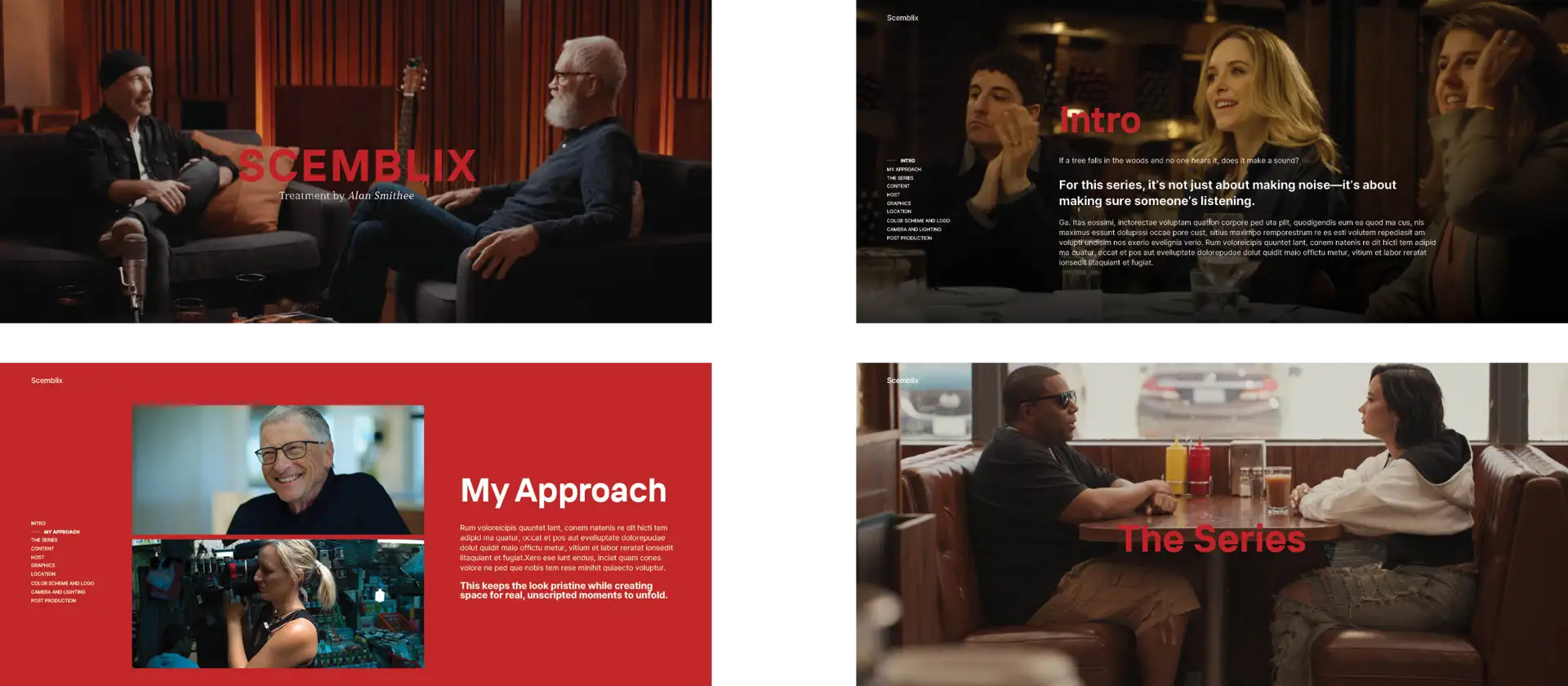
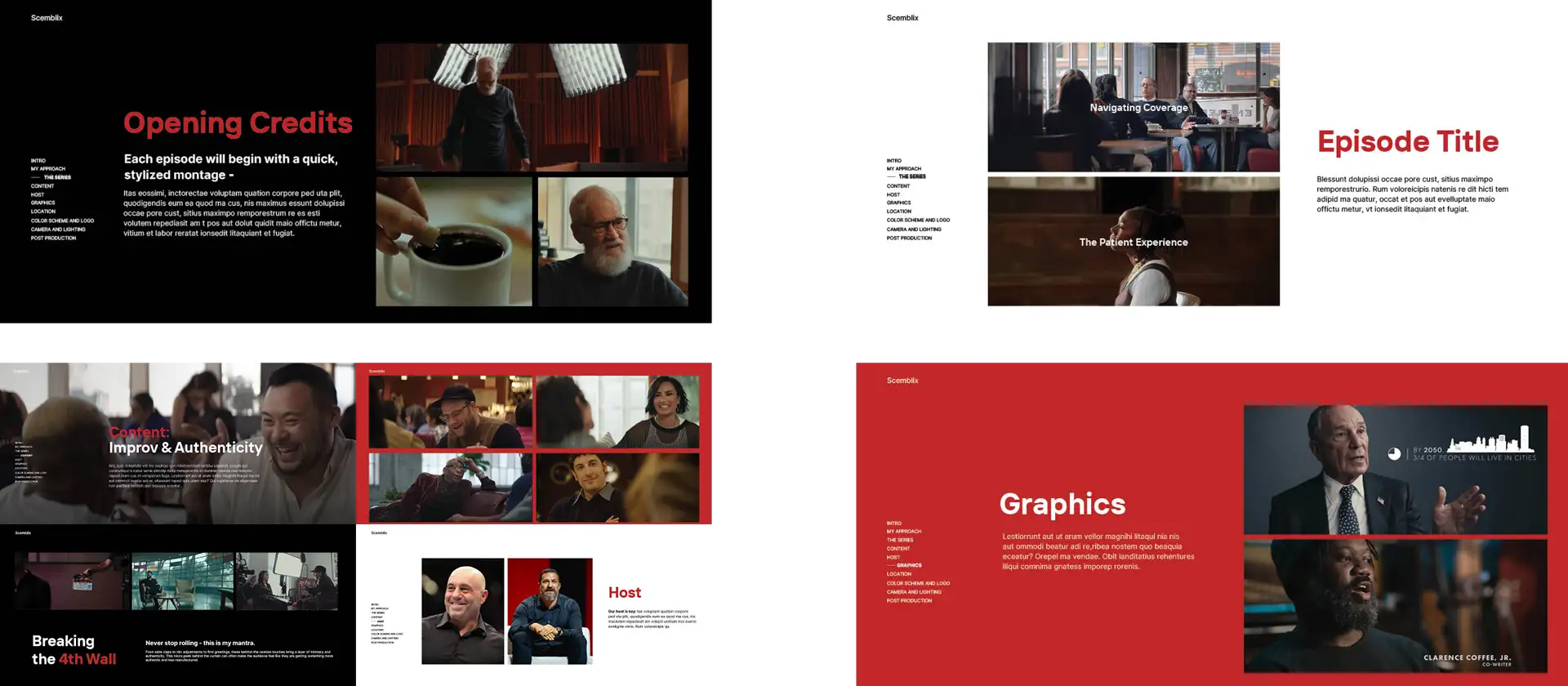
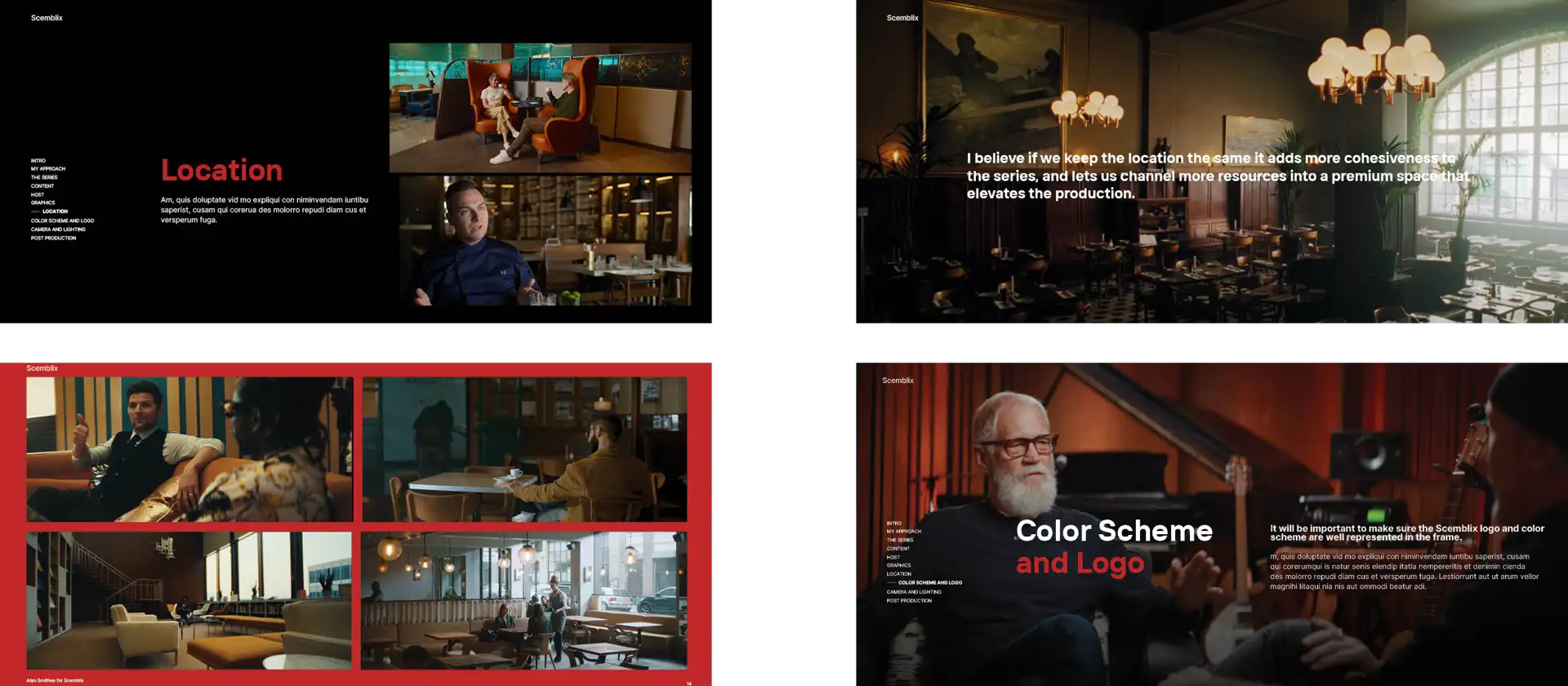
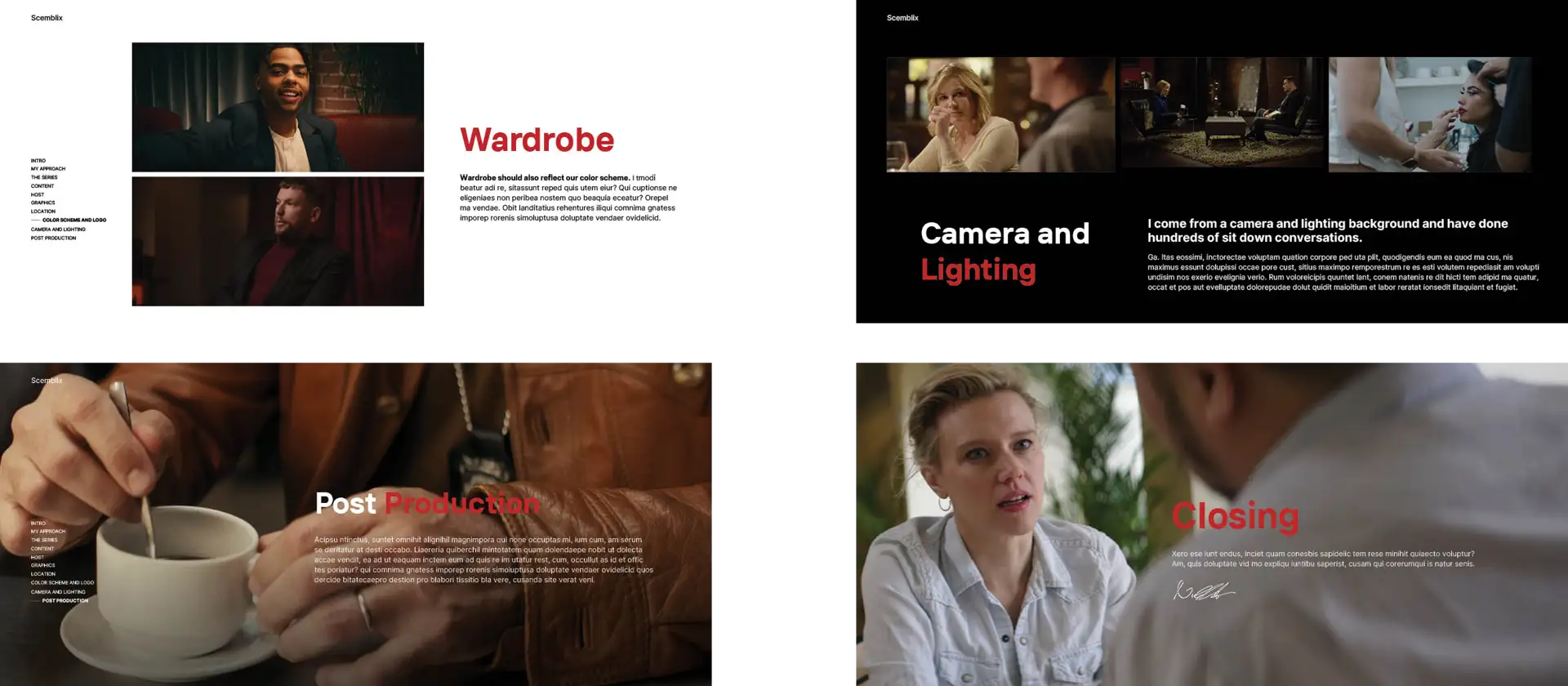
Video treatment templates provide a structured approach to conceptualizing the style, narrative, and tone of a video project. These video treatment templates allow your writer, director, and client to visualize the big concept, key scenes, and visual style prior to production. With defined sections for tone, shots, and flow, teams can stay aligned and save time. To use these templates well, understanding the core components provides a powerful foundation for the project.
*Based in Los Angeles, Available Worldwide
WRITING | DESIGN | AI VISUALS
Video Treatment Templates: How toCreate Your Own
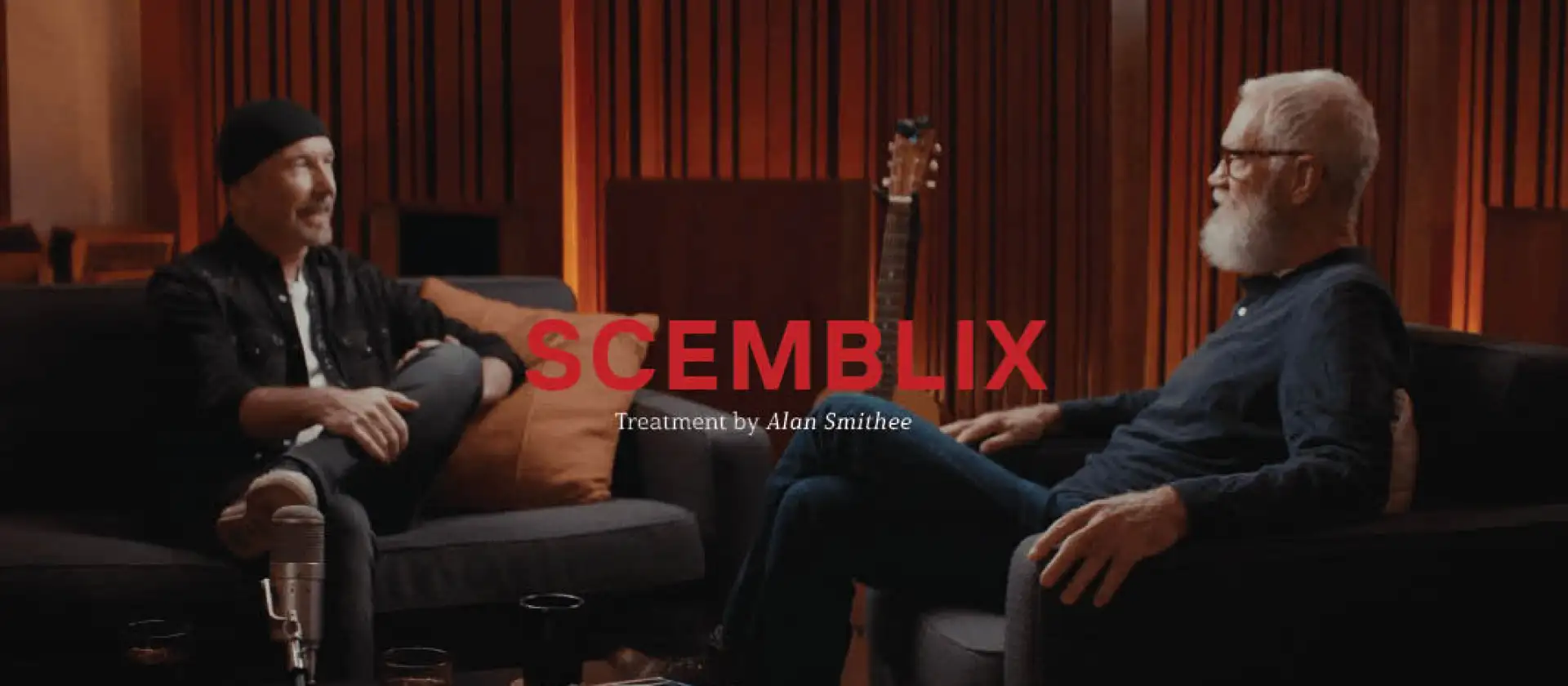
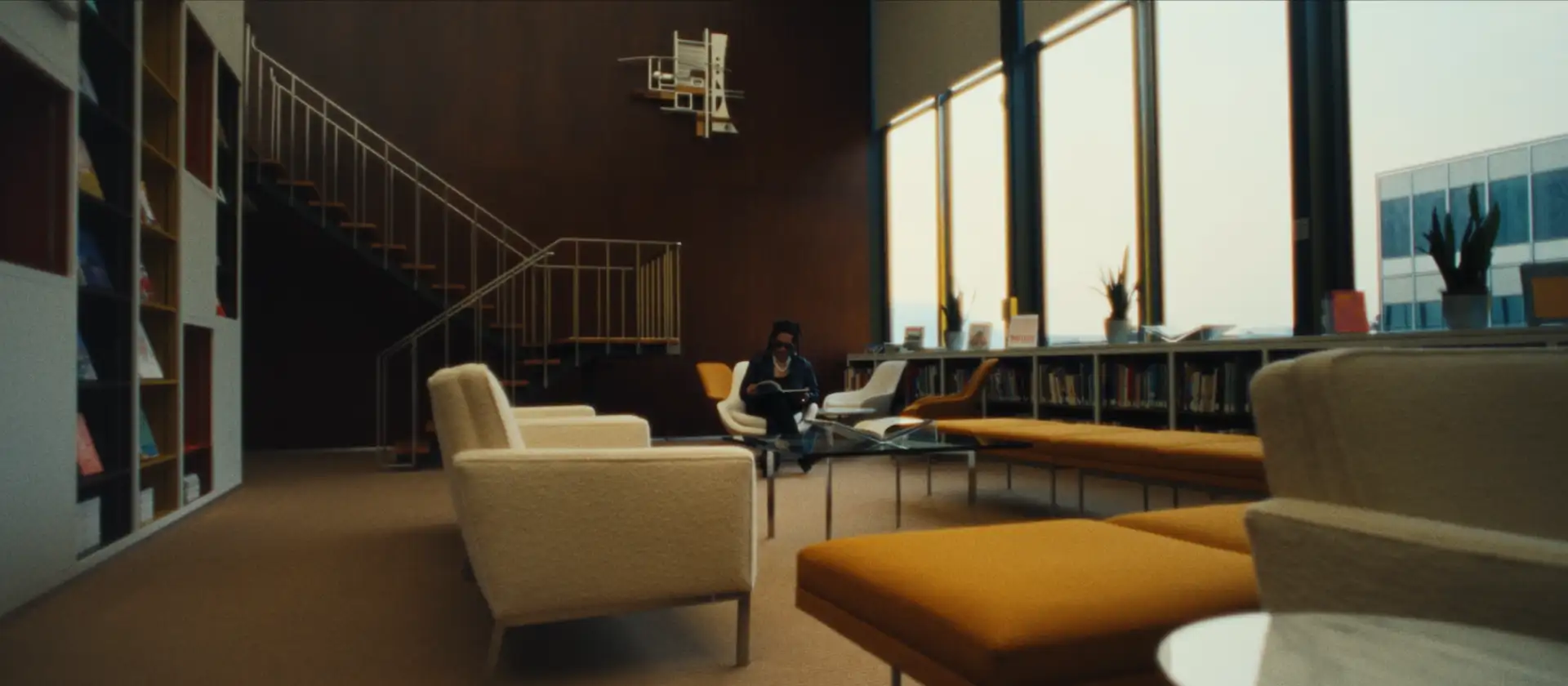
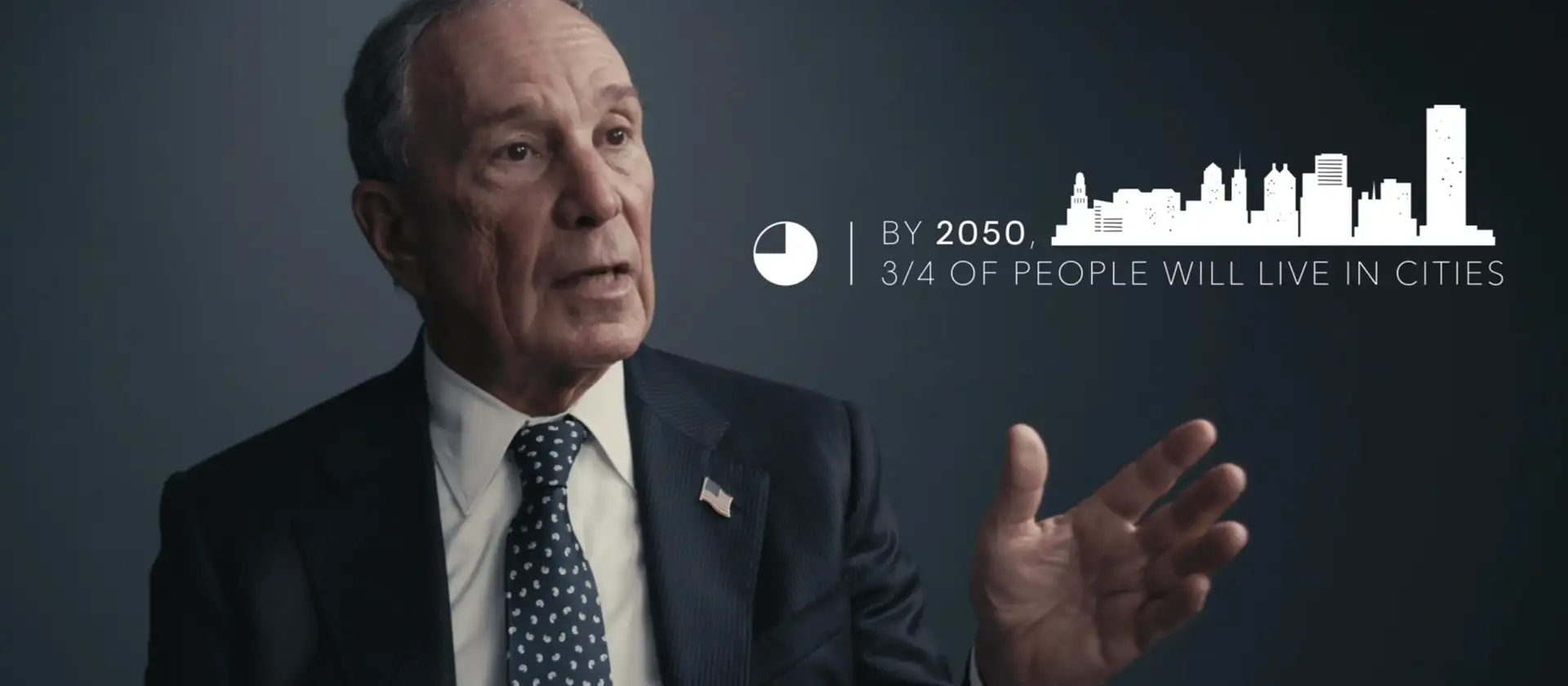
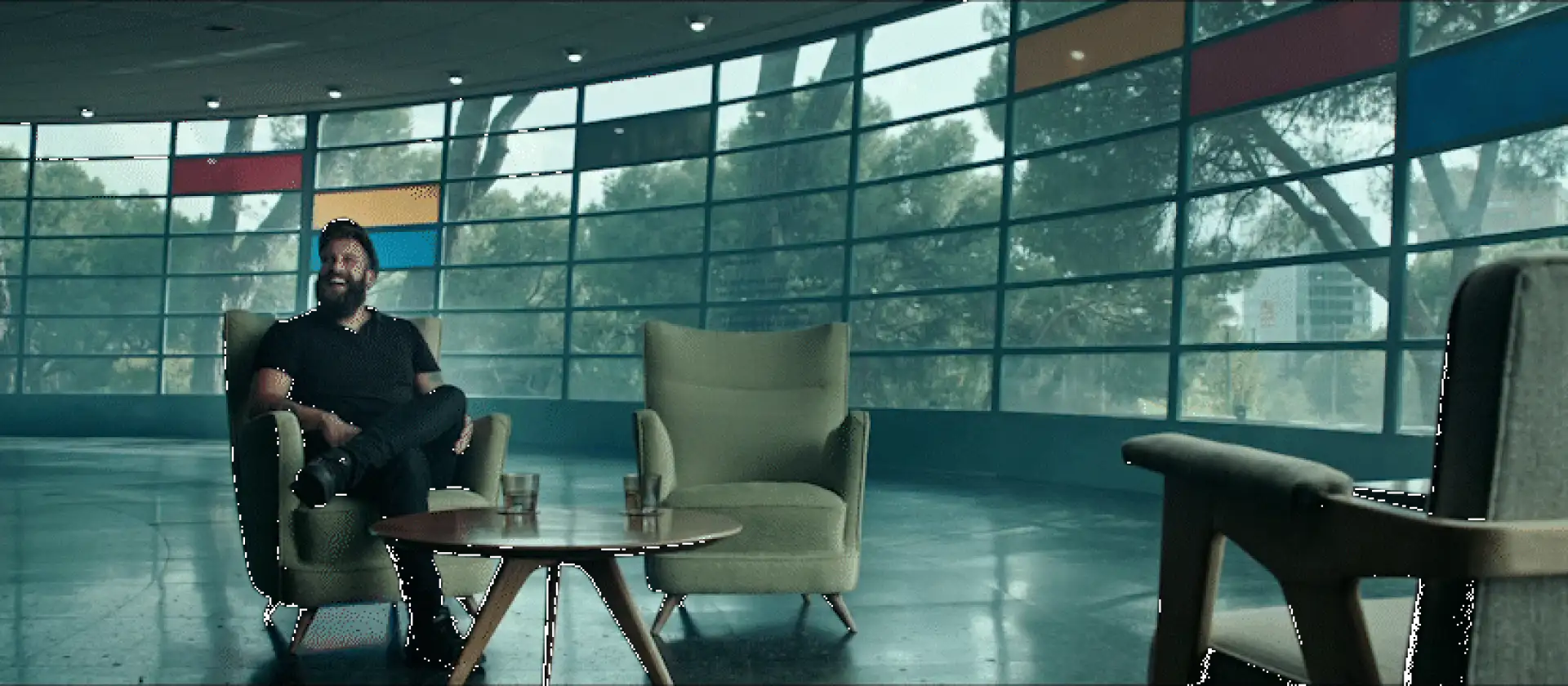
Scemblix Treatment
Credit: Visual Research | Treatment Design
Type: Designers
Video Treatment Templates: Key Takeaways
- While it’s necessary to nail down a solid core theme and narrative structure, creating a universal video treatment templates that appeals to anyone, anywhere will be a lot harder.
- By describing a clear creative vision in vivid imagery, you amplify your project’s emotional resonance and get stakeholders excited while being faithful to your message.
- Knowing your audience with the demographic breakdown is the key to tailoring your messaging and content, making it much more engaging and relevant.
- Staying consistent in tone and visual style aids clarity and reinforces your audience’s connection. Mood boards and references help you visualize and communicate your desired aesthetic.
- Tailoring your video treatment example PDF for genres like commercials, films, and documentaries guarantees that every project satisfies industry expectations and captures distinct narrative needs.
- By weaving in interactive elements, multimedia, and collaboration tools, you’re not only enhancing the treatment presentation, you’re optimizing it for team input, flexibility, and future-proofing in an increasingly dynamic media environment.
Video Treatment Templates Parts
Video treatment templates are not only a checklist; it’s the foundation of each successful video endeavor. Each step compounds on the previous one, crafting the story, tone, and communications. Clarity and flow are paramount for audience comprehension. If you skip steps or add fuzzy details, it causes confusion and makes your final product loose. Understanding the fundamentals and how all the pieces connect prevents rookie errors and gives every draft a powerful beginning.
1. The Core
Beyond The Blueprint The core is the heart of your therapy. It is the big picture or concept that connects everything. Lacking a strong core, the video risks becoming diffuse. Consider what you want them to take away. If your project is about climate action, your core theme could be something like “little things add up.” Every aspect of your video treatment templates, from pictures to conversation, should resonate with this message. Once the core aligns with the video’s aim, it can help direct decisions further down the line and keep crews focused.
2. The Vision
A vision makes the project real. It’s not really about visual, it’s about how you want people to feel. Caption with short, direct phrases to demonstrate what the audience will view. For instance, “A slow-motion shot of rain pelting city streets” paints a picture. It’s your vision that captivates them and helps the rest of the team see what you’re trying to accomplish. A compelling vision assists in generating support from sponsors and partners who want to understand what differentiates your video. Above all, the vision should seek to inspire feeling—be it hope, excitement, or curiosity.
3. The Audience
Knowing your audience informs every decision. Begin by nailing down the age, interests, and habits of who will watch. If your audience is young professionals, make the copy clean and the art fresh. Research what’s hot and see what comparable audiences like. Maybe quick cuts, bright hues, or rapid edits. Run it by sample viewers if you can. The more you tailor your treatment to your audience’s preferences, the more successful your message will be!
4. The Tone
Choose a tone that suits the message. A serious tone fits health or education, and a light tone fits product launches or travel videos. Experiment with different tones in drafts. Once you set the tone, maintain it. Abrupt changes can disorient your audience. The tone affects response. Warm tones generate trust and bold tones prompt action.
5. The Visuals
Visuals bring ideas to life. Select a style — minimal, bright, hand-drawn, cinematic — appropriate to the theme. Reference movies, commercials, or even artworks that inspire. For a tech explainer, think clean lines and cool blues. For storytelling, image mood boards can assist groups visualize the appearance. Great visuals complement the story, enhance the emotions, and make the point even more powerful.
Tailoring Your Video Treatment Templates
Video treatment templates have to conform to the story and intention behind every project. A one-size-fits-all approach can miss the mark, so the best results come from adapting your template to suit the style of video you want to create. Your pitch should meet industry standards, use appropriate language and format, and ensure you include all necessary components.
For Commercials
Commercial video treatments work best when they get to the point quickly. You want the headline to pop out within the first few sentences. Use simple words and short sentences so viewers don’t get bored. For instance, a template for a sports shoe ad could start out with aggressive statements about comfort and performance and then flow directly into images of the shoe in use.
Emphasize what separates the product or brand from the others. Call out your unique selling points using bullet points or short sections in your template. Include a call-to-action at the bottom like “go to our site to purchase.” Check out winning ads and how they combine attention-grabbing imagery with verbs that demand action.
Always check your draft against a list of industry must-haves: brand summary, target market, main message, tone, visuals, and call to action.
For Films
A film treatment template has to be much broader. Begin with a succinct summary of the story, then outline the primary arc. Describe the arc your characters take, with suggestions of how they evolve. For instance, in a coming-of-age film, the video treatment templates will describe the lead’s struggle and development, including the turning points.
Use your template to break the story or your main beats. Incorporate sections for themes and motifs, such as hope or betrayal, and provide visual mood cues. Mention pacing: show how the suspense builds or when the audience should feel tension break. This keeps the treatment focused and helps others envision how the film will maintain interest.
Do not forget to check: summary, plot points, character sketches, themes, mood, and pacing notes.
For Documentaries
For documentaries, write fact-based video treatments. Tell what research entered into the effort and how you intend to keep accurate. Frame the narrative in easy language that pulls your audience in. For instance, a template on climate change might begin with data and then shift to depicting real people who experience its impact.
Get specific about ethics. Demonstrate how you will handle sensitive issues or interviewees. Insert a permissions/fact check box. Tailor your template to the query flow, for example, ask a question and then present findings stepwise. This allows all of us to visualize the narrative.
Always confirm research sources, narrative outline, ethical notes, structure, and permissions.
The Persuasive Pitch
Video treatment templates shape your project’s story, style, and direction before any footage is shot. They’re a roadmap, directing your every move. When you pitch your treatment, you need a direct, forceful strategy that demonstrates your project’s worth, remains client-centric, and tackles reservations with candor and accuracy.
Client Focus
- List the client’s main goals in order of importance.
- Fit your creative decisions to the client’s brand and message.
- React quickly to criticism and revise the video treatment example.
- Demonstrate clear connections between project milestones and the client’s goals.
Clients want to see their needs front and center. A great treatment demonstrates you’ve heard them and you get what they care about. If a client values speed, show how your plan will keep timelines tight. If quality is key, highlight the controls you will use to maintain high standards.
Remaining flexible is critical. Every client comes with different expectations, and your approach must move with their feedback. Support your decisions with quotes or previous case studies. For instance, if a client adored a quick tempo in previous videos, explain how you will maintain that pulse.
As much as you can, delineate between your concepts and theirs. If the client seeks to target a younger consumer, demonstrate how your idea will communicate with that audience through tone, music, or imagery.
Creative Integrity
Creative integrity is sticking to your vision in collaboration. It’s a tuning between forming new concepts and serving market demand. Occasionally, the brazen move distinguishes your work. If you do, tell them what makes yours valuable—perhaps a novel animation style or a non-linear narrative.
Having said that, you have to listen. If the client requests modifications, think about how you can preserve your essence while still accommodating their needs. For instance, if they want a shorter video but you mapped out more, consider canning scenes while keeping the major story beats.
Other times, fresh insight from the team or client breathes life into a project. Remain flexible, though you can always see if the new information matches your vision. Reference real work again or pop examples to demonstrate why your approach works.
Budget Clarity
Let your strong video treatment speak to the costs. Be transparent about what each component will cost and why. If you need to rent gear or hire additional crew, state it. Don’t surprise them later.
- Equipment rental
- Crew wages
- Location fees
- Post-production editing
- Music licensing
- Marketing and distribution
Be honest about potential financing. Propose partnerships with brands, grants, or even crowd-funding if necessary. Here are some examples of similar projects that employed these tactics. If a client frets about price, itemize exactly where each euro goes and present solutions for scaling up or down.
Avoiding Generic Traps in Video Treatment Templates
Video treatment templates are a great place to start, but they just as often shove projects into a mold that comes out tired if you’re not mindful. The risk is clear: templates make it easy to fall into patterns filled with overused ideas or flat characters. Identifying these traps is crucial for anyone who hopes their work resonates and distinguishes themself.
Trite clichés and stereotypes tend to creep into video treatments, blurring stories together as opposed to making them pop. Some examples to watch out for include:
- The “chosen one” plot — where a lone hero saves the world with minimal assistance.
- Flat sidekicks who live only to support the protagonist.
- City skylines or sunsets serve as proxies for authentic feeling.
- Falling back on slow-motion or dramatic zoom-ins to indicate importance.
- Characters with no real flaws or growth.
- Generic “inspirational” music cues at the same story beats.
- Trendy clichés that slavishly mimic something hot but don’t bring anything to the table include dystopian or post-apocalyptic worlds and forbidden love without new context.
Dodging these traps requires a stretch toward new thinking and courageous decisions. Seek to decenter the discussion from herd behavior.
Originality Always Wins
True tales usually originate from tiny truthful particulars. Instead of employing a city skyline to illustrate loneliness, depict a character’s daily life or micro-habits. Replace the generic hero with a ragtag team of misfit friends who work things out together, or allow the background characters to have their own arcs and voices. Local music or uncommon visual styles can tell a story that feels grounded and fresh. Little touches like these give a treatment its own character and make it memorable.
To find out what works, examine award-winning or praised video treatment templates in your discipline. Deconstruct them to discover what decisions they made regarding voice, mood, and imagery. For instance, the spec for ‘Fleabag’ distinguished itself by having the protagonist break the fourth wall in a uniquely visceral and immediate manner. Moonlight avoided generic traps too, eschewing vast sets or effects in favor of colors and close shots to build mood. Both sidestepped cliché and stereotype-infested templates and instead constructed tales that could only be theirs. If you inquire into what distinguishes a memorable treatment, you can steer your own work toward new territory.
The Interactive Treatment
Interactive video treatment templates immerse viewers in the narrative, not as passive observers, but as engaged protagonists. This redirects attention from one-way messages to two-way exchanges, allowing users to influence what they view and how they react. Interactive treatments typically employ clickable options, inline feedback or live data to increase interactivity. For project teams and stakeholders, interactive templates help make plans clearer and invite more collaboration. In this section we describe how to add interactivity, leverage technology for immersive experiences, and gather actionable feedback for continual optimization.
Embedded Media
Multimedia elements, such as brief videos or high-quality photographs, assist in illustrating concepts that text can’t. A short animation can explain how a product functions, whereas a slide show can emphasize the significant moments in a narrative. When nestled in video treatment templates, these chunks of media disrupt text and maintain the audience’s focus.
All media should be appropriate to the story’s tone and goal. For a training video, include sequential stills or clips. For a short film, include mood boards or color palettes. Check all embedded media to make sure it loads and plays correctly on various devices and browsers. This prevents broken links or slow loading, which can kill the momentum. Make sure to always caption or use alt-text for accessibility.
Dynamic Links
Incorporating links allows readers to explore further into any section of the treatment. You’ll link to a sample video treatment, research, or previous work-in-progress versions. For stakeholders, links provide instant access to budget sheets, schedules, or regulatory standards.
Link to where it feels right, such as immediately after a bold statement or at the end of a paragraph. Don’t clutter the page with too many at once, but use them to direct, not inundate. About The Interactive Treatment An old link can damage credibility and drag out decisions. A good clean link demonstrates attention and keeps all on the same page.
Collaborative Tools
Inviting team feedback takes a good treatment and makes it great. Utilize shared online docs or boards where members can jot notes or propose edits. This keeps ideas flowing and helps identify problems early. Allowing everyone to chip in makes the ultimate plan more robust and comprehensive.
Project management tools assist in monitoring what each individual is working on, establishing deadlines, and staying updated on edits. Some sites will even let you see who changed what or comment inline. Leveraging these tools can keep teams on track, even between time zones.
|
Tool Name |
Main Feature |
Best Use Case |
Accessibility |
|---|---|---|---|
|
Google Docs |
Real-time editing |
Script drafts |
Web, mobile |
|
Trello |
Task boards |
Timeline planning |
Web, mobile |
|
Slack |
Team chat, file sharing |
Quick feedback loops |
Web, mobile, desktop |
|
Frame.io |
Video review, comments |
Visual feedback |
Web, mobile |
Future-Proofing Your Vision
To future-proof your video treatment templates for a fast-changing world, creative teams and planners search for ways to construct ideas that work today and endure as new trends and tools arrive. This involves constructing templates that suit both the demands of the project and the changes in the broader industry.
How to Future-Proof Your Director’s Treatment
Seek out what’s fresh in visual style, storytelling and audience habits around the world. For instance, the proliferation of short form vertical videos on TikTok and Instagram Reels suggests templates need to account for both classic landscape and newer portrait orientation. Think about how worldwide audiences now demand diverse casting and multilingual subtitling. Apply general research-based insights so your template can assist groups identify and leverage these trends, allowing you to conveniently exchange elements or insert new parts as styles change.
The flexible pieces in a treatment allow you to adjust your vision without having to start from square one. Construct fragments that facilitate simple adjustments in tone, duration, or format. For example, a music video template might have choices for either narrative or performance-based scenes, allowing users to select what suits. Write in plain language and explicit steps so that new team members, no matter the background, can easily understand and update the template. Leave open fields for various budgets, locations, and cast sizes, so the treatment can apply for a big city or small town shoot. Include notes that remind users to consider local traditions or regulations, letting the template function globally.
Scalability is a key piece of a solid video treatment. Projects are often born small but with additional funding or attention suddenly have no choice but to grow quickly. Templates should allow users to incorporate or remove scenes, expand or shrink the crew, and shift timelines without disrupting the continuity. Provide examples of lean and large scale shoots. For a branded campaign, provide routes for one-off videos or an entire series so the clients can envision how to deploy the same concept in additional locations.
Future-proof your vision
As 4K, VR, or AI-powered editing becomes more widespread, templates need to have placeholders for them. For example, outline where drone shots, time-lapse effects, or subtitles may go. Use metrics for shot distances and lighting so teams anywhere in the world can keep up. As cloud-based editing and remote teams scale, include checklists for file sharing and feedback tools.
Conclusion: Video Treatment Templates
Video treatment templates provide a clean beginning for any endeavor. They assist teams in presenting powerful concepts quickly and maintaining projects on schedule. We use them to establish style, choose atmosphere, and map out every action. A great template saves time and keeps everyone focused. Real teams mold each template to real objectives, from a quick product demo to a longer narrative. Doing something a little different or introducing new tools helps keep ideas fresh. Templates work best when teams exchange feedback and revise them frequently. To take your next video out of the ordinary, experiment with a template that suits your crew. Discuss, experiment with layouts, and craft a schedule that suits all.
Frequently Asked Questions: Video Treatment Templates
What are video treatment templates?
Video treatment templates are a formatted document that describes your video’s idea, aesthetic, and method. It makes your vision more organized and shareable with clients and teams.
Why should I customize video treatment templates?
Personalizing templates makes your project unique. It ensures you tailor the treatment to your specific objectives, demographic, and brand persona. This is key for making your pitch compelling and distinct.
How can I avoid making my video treatment too generic?
Be specific in what you want, targeting details like tone, visuals and messaging. Customize your template with your project’s goals and aesthetic. Don’t use abstract words or cookie-cutter approaches.
What makes a persuasive video treatment pitch?
An effective pitch succinctly lays out your vision, benefits, and why the video satisfies your client’s needs. Write tight, be visual, and be bold.
Are interactive elements important in a video treatment?
Yes, sprinkling some interactive elements like storyboards or mood boards can assist in painting a picture of your concepts. They help make your treatment more interactive and digestible.
How do video treatment templates help future-proof my project?
Templates promote consistency and organization. They simplify keeping your project up to date as trends or client demands shift, keeping you current.
Can I use video treatment templates for any type of video project?
Yes, templates are flexible. They work for commercials, documentaries, corporate videos, and more. You can customize them for your own project.