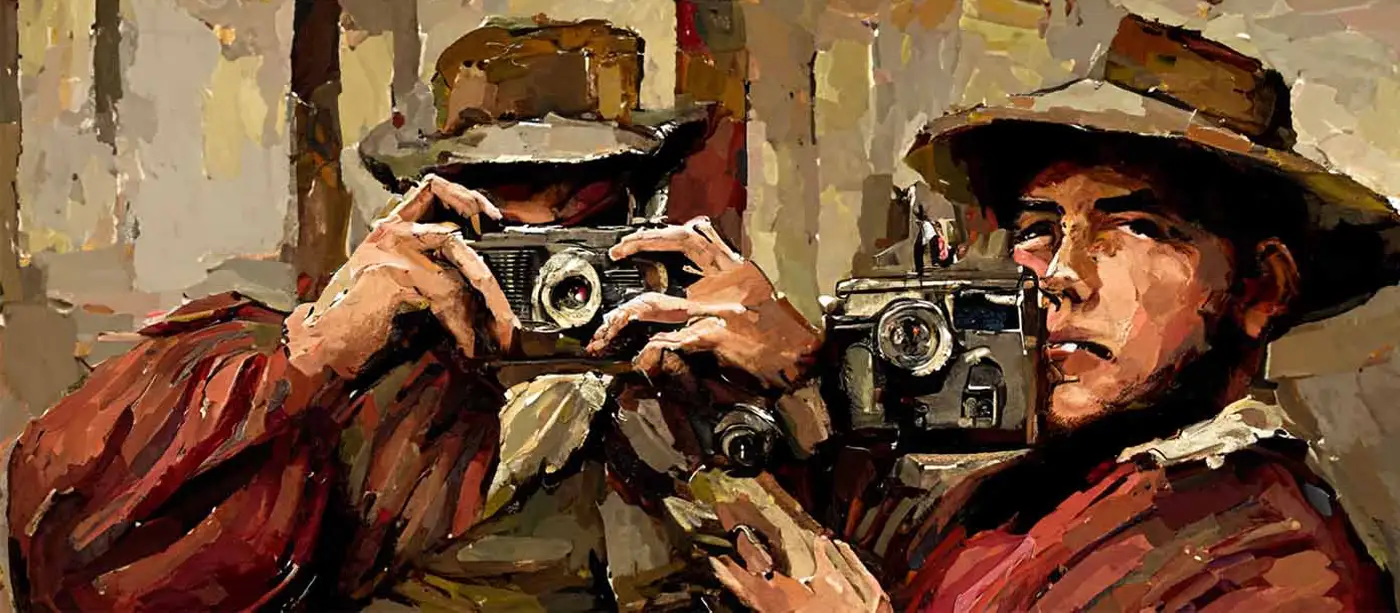
Movies have been around for over a hundred years. However, they’ve come a long way since the first camera was invented. Two brothers from France started it all. At first, films were silent and short. But then, sound was added in the late 1920s. This changed everything and led to the creation of modern-day movies.
As film historians can attest, there’s much more to this story than meets the eye. Join us as we delve deeper into filmmaking history and discover how this art form has evolved over time.

The First Motion Pictures
Eadweard Muybridge: The Pioneer of Motion Pictures
The history of filmmaking dates back to the late 1800s. This is when Eadweard Muybridge, a British photographer, created the first motion picture. In 1878 using a series of cameras capturing photographs in quick succession and projecting them onto a screen, he invented a device called the zoopraxiscope. This invention paved the way for modern cinematography and inspired many filmmakers experimenting with motion pictures.
Louis Le Prince: The Father of Moving Pictures
While Muybridge is credited with creating the first motion picture, it was Louis Le Prince invented the first ever moving picture. In 1888, he used a single-lens camera to capture footage of people walking and performing various activities on Leeds Bridge in England. Although his invention was groundbreaking in filmmaking history, Le Prince’s work was cut short when he disappeared mysteriously in 1890 before he could patent his creation.
The Lumière Brothers: Pioneers of Public Screening
In 1895, French brothers Auguste and Louis Lumière held the first public screening of a motion picture at Salon Indien du Grand Café in Paris. Their invention, called the Cinématographe, allowed them to shoot and project films using one machine. They showcased several short films that amazed audiences with their lifelike quality and realism.
Charles Tait: Creator of Feature-Length Films
The first feature-length film made is by Australian director Charles Tait in 1906. “The Story of the Kelly Gang” was an hour-long movie that depicted the life story of infamous outlaw Ned Kelly and his gang. This film set new standards for storytelling and production value that would influence future filmmakers for generations.
Evolution and Development of Film
Early Techniques for Moving Pictures and Projection
The history of filmmaking dates back to the late 1800s upon the invention of the first motion picture camera.. However, the technology behind film emerged mostly from developments and achievements in the fields of projection, lenses, photography, and optics. Let’s take a look at some filmmaking history’s early techniques that involve moving pictures and/or projection.
- Shadowgraphy: One of the oldest forms of visual entertainment involving shadow images using hand gestures or cut-out figures against a light source. Historians believe that this technique has been in practice since prehistoric times.
- Camera Obscura: A natural phenomenon where light enters through a small hole or aperture into a darkened room or box, projecting an inverted image onto a surface opposite to the aperture.
- Shadow Puppetry: Originating around 200 BCE in Central Asia, India, Indonesia, and China. This technique manipulates flat cut-out figures made from leather or paper against a screen illuminated by candlelight.
- Magic Lantern: Developed in the 1650s as an improvement over earlier incidental and/or inferior projectors. It uses light passing through glass slides with painted images projecting enlarged images onto walls or screens.
- Stroboscopic: A form of animation from the early 19th century. Stroboscopic devices create optical illusions by presenting sequential still images at high speeds to create an illusion of motion through persistence of vision. Examples include phénakisticope since 1833, zoetrope since 1866, flip book since 1868.

The Novelty Era and International Growth
Commercial Filmmaking Emerges in the Novelty Era
The late 1800s marked the beginning of commercial filmmaking, known as the “Novelty Era.” Characterized by short films showcasing new technologies, this novelty captured scenes of everyday life. In 1895, the Lumière brothers in France invented a portable motion-picture camera and projector, which they called the Cinematographe. This invention paved the way for filmmakers to capture moving images on film and project them onto large screens.
One of the earliest examples of commercial filmmaking is The Arrival of a Train at La Ciotat Station (1895), directed by Auguste and Louis Lumière. This short film shows a train pulling into a station, with passengers disembarking from it. The lifelike representation of reality on screen amazed audiences globally.
First International Film Screening in Paris
In 1896, the first international film screening took place in Paris. The event featured films from France, Germany, and the United States. One of the most popular films shown was The Serpentine Dance (1895) by French filmmaker Louis Lumière.
This event marked an important milestone in filmmaking history because it demonstrated that movies could transcend national boundaries and appeal to audiences around the world.
Emergence of Longer Narrative Films
During the early 1900s, longer narrative films began to emerge. These films told stories through moving pictures and featured more complex plots than earlier short films. One notable example is The Great Train Robbery (1903), directed by Edwin S. Porter. This Western-themed film tells the story of a group of bandits who rob a train and then get pursued by law enforcement.
Another significant film from this era is Birth of a Nation (1915), directed by D.W. Griffith. Although controversial today because of its racist content, this epic film was a technical masterpiece that introduced new storytelling techniques, such as parallel editing and close-ups.
Film Production Spreads Internationally
As the film industry grew during this era, it spread to other countries. Italy, Russia, and Japan were among the countries that made significant contributions to early filmmaking. In Italy, filmmakers such as Giovanni Pastrone created epic films like Cabiria (1914), which featured elaborate sets and costumes.
In Russia, Sergei Eisenstein revolutionized filmmaking history with his innovative use of montage in films like Battleship Potemkin (1925). Japanese filmmakers also made important contributions to the art form with classics like Yasujiro Ozu’s Tokyo Story (1953).
Impact on Future Advancements
The growth of the film industry during this era paved the way for future advancements in technology and storytelling techniques. For example, sound was added to movies in 1927 with The Jazz Singer. Color films became popular in the 1930s with classics like The Wizard of Oz (1939) and Gone with the Wind (1939).
Filmmakers also experimented with new camera angles and movements to create more dynamic images on screen. Alfred Hitchcock’s Vertigo (1958) is an excellent example of this trend.
History of Film Timeline: All Eras of Film History
The Birth of Film: Late 1800s
Filmmaking history dates back to the late 1800s when the motion picture camera was first invented. Thomas Edison and his team at Edison Laboratories developed the Kinetoscope, a device that allowed one person to view moving pictures through a peephole. However, until the Lumière brothers’ Cinématographe film projection wasn’t possible.
Silent Era: Late 1800s – Late 1920s
During the silent era, films were without synchronized sound, and actors had to rely on exaggerated facial expressions and body language to convey emotions. This era saw the rise of classics like “The Great Train Robbery” (1903) and “Nosferatu” (1922), as well as comedies featuring stars like Charlie Chaplin and Buster Keaton.
Despite their decline in popularity, silent films continue to be appreciated for their unique contribution to the art of filmmaking. Without dialogue, filmmakers had to rely on other filmmaking elements such as music, lighting, camera angles, and editing techniques to convey emotions and tell stories. This resulted in some truly innovative filmmaking techniques that are still studied today.
The Rise and Fall of Silent Films
Silent films were once the dominant form of cinema, but their popularity began declining in the late 1920s with the introduction of sound technology. Prior to this, silent films relied on visual storytelling through exaggerated acting and elaborate sets conveying emotions and plot points. However, with the advent of sound technology, dialogue became a crucial aspect of films, leading to a shift in the industry towards more dialogue-driven narratives.
The introduction of sound technology also had significant financial implications for studios. Many silent film actors did not have voices that matched their on-screen personas or accents appealing to audiences. As a result, studios had to invest heavily in new talent and equipment to make the transition from silent films to “talkies.” This led many studios to go bankrupt or merge with larger companies forever changing filmmaking history.
Golden Age of Hollywood: 1930s – 1960s
The Golden Age of Hollywood is widely considered one of the most significant eras in filmmaking history. Major studios produced some of the most iconic films in history during this time, including “Gone with the Wind” (1939), “Casablanca” (1942), and “Singin’ in the Rain” (1952). The era also saw an increase in movie theaters across America, with people flocking to see their favorite stars on the big screen.
One of the reasons why this era was so successful was due to advancements in technology that allowed filmmakers to create more visually stunning movies. For example, the introduction of widescreen formats like Cinemascope in the 1950s, allowed for larger-than-life images projected onto giant screens. Sound technology had improved significantly since its introduction in “The Jazz Singer” (1927), leading to better quality audio for moviegoers.
Another reason for the success during this time was due to strict censorship laws enforced by organizations such as the Motion Picture Production Code (also known as Hays Code). This code regulated what could and couldn’t be shown on screen helping maintain a certain level of morality within films.
The Development of Color Film
The development of color in filmmaking history began in the early 1900s with various processes such as Kinemacolor, Prizma Color, and Dufaycolor. However, Technicolor became the dominant color process in the 1930s. The three-strip Technicolor process used a camera with three separate rolls of black-and-white film that captured red, green, and blue light separately. These three strips were then combined to create a full-color image.
New Hollywood Era: Late 1960s – 1980s
The New Hollywood era emerged in response to changing social attitudes and political unrest in America. Filmmakers began experimenting with new styles and themes, resulting in groundbreaking movies like “Bonnie and Clyde” (1967) and “Easy Rider” (1969). The era also saw a shift towards more socially conscious filmmaking, with movies like “The Godfather” (1972) and “Taxi Driver” (1976) tackling issues like organized crime and mental illness.
Rise of Independent Cinema: 1990s
The 1990s saw the rise of independent cinema, with filmmakers like Quentin Tarantino and Kevin Smith gaining popularity. Characterized by a diversification of film styles and voices, as well as an increased focus on international cinema, this era created new cinema renegades. Movies like “Pulp Fiction” (1994) and “Clerks” (1994) became cult classics, paving the way for a new generation of filmmakers to make their mark on the industry.
Digital Revolution: 2000s – Present
Today, the revolution of digital technology forever changed the way films are made and distributed. The rise of streaming platforms like Netflix and Amazon Prime changed the landscape of the industry. It became easier for independent filmmakers to get their work seen by a wider audience. The use of CGI in movies has also become more prevalent, allowing filmmakers to create stunning visual effects that were previously impossible.

By Bundesarchiv, Bild 183-1990-1002-500 / CC-BY-SA 3.0, CC BY-SA 3.0 de, Link
Wartime in Filmmaking History
Boosting Morale and Manipulating Public Opinion
Filmmaking history has seen the creation of many movies with different purposes. During wartime, films served as a tool for boosting morale and support for the war effort. Hollywood studios produced a significant number of propaganda films during World War II to convince Americans that they were fighting for a just cause. These movies aimed to inspire patriotism and encourage citizens to contribute to the war effort in various ways.
Propaganda films, on the other hand, have been used throughout history to manipulate public opinion and promote specific political agendas. The use of propaganda in films has been controversial, with some arguing that it is a necessary tool in times of war, while others believe it is unethical and manipulative.
Hollywood’s Contribution
During World War II, Hollywood played an essential role in producing propaganda films for the US government. These movies’ design intended to boost morale at home by depicting American soldiers as brave heroes fighting against evil forces. They also served as a way to recruit new soldiers by showing how important their contribution was to winning the war. Although artistically questionable, they still have their place in filmmaking history.
One notable example is Frank Capra’s “Why We Fight” series, which consisted of seven documentary-style propaganda films commissioned by the US Government during WWII. The series captured America’s involvement in the war and the importance for Americans to both support and actively participate in it.
Leni Riefenstahl’s Nazi Propaganda Films
While Hollywood was busy creating pro-American propaganda films during WWII, Leni Riefenstahl was making highly influential Nazi propaganda films such as “Triumph of the Will.” Riefenstahl’s work glorified Adolf Hitler and portrayed him as a messiah-like figure who would lead Germany into a new era of prosperity.
Utilizing innovative techniques such as aerial shots and slow-motion sequences, it was the first time documentary-style film adopted these elements. Highly effective in shaping public opinion in Germany, it was a tool to manipulate the masses into supporting Hitler’s regime. Although this is a dark stain on world history, the psychology and techniques of narrative penetrated many industries, shaping the future, and forever holding its rightful place in filmmaking history.
The Ethics of Propaganda
The use of propaganda in films has always been controversial. Some argue that it is necessary during times of war to boost morale and support for the cause. Others believe that it is unethical and manipulative to use films to promote political agendas.
Propaganda is defined as the dissemination of information, ideas, or opinions seeking to influence or manipulate the public’s opinion. When done correctly, propaganda can be an effective tool for swaying public opinion towards a specific goal or objective. However, used unethically, it sometimes leads to disastrous consequences.
Postwar Film Movements
Emergence of Postwar Film Movements
After World War II, the world was left with a sense of disillusionment and despair. This feeling directly reflected in the emergence of postwar film movements. These sought to explore new ways of portraying reality on the big screen. The post-war movement rejected the traditional Hollywood-style filmmaking and their emphasis on experimentation, realism, and social commentary. This unique feature helped forever cement its place in filmmaking history.
Italian Neorealism
One of the most significant postwar film movements was Italian neorealism. Emerging in Italy during the late 1940s and early 1950s, this movement focuses on realistic portrayals of everyday life. Italian neorealist films often dealt with themes such as poverty, unemployment, and social inequality.
Films like Vittorio De Sica’s “Bicycle Thieves” (1948) depicted ordinary people struggling to make ends meet in post-war Italy. The use of non-professional actors, natural lighting, and real locations added to the authenticity of these films. Italian neorealism profoundly influenced filmmakers around the world. It’s celebrated for its humanistic approach to storytelling.
French New Wave
Another influential postwar film movement was French New Wave. This movement in filmmaking history emerged in France during the late 1950s and early 1960s and emphasized experimentation and unconventional storytelling techniques. French New Wave directors rejected traditional Hollywood-style filmmaking conventions like linear narratives, polished cinematography, and professional actors.
Instead, they embraced jump cuts, handheld cameras, location shooting, improvisation, and non-linear editing techniques. It broke down barriers between fiction/documentary styles as well as metafictional elements. For the time, that was unconventional. Films like Jean-Luc Godard‘s “Breathless” (1960) challenged audiences with their fragmented narratives and self-reflexive style.
French New Wave had a significant impact on the development of cinema around the world, inspiring filmmakers to experiment with new techniques and styles.
German Expressionism
German Expressionism was a postwar film movement that emerged in Germany during the 1920s. This movement used distorted visuals to convey psychological themes such as fear, anxiety, and madness. The films produced during this period characteristically use shadowy lighting, exaggerated camera angles, and stylized sets.
Films like F.W. Murnau’s “Nosferatu” (1922) and Robert Wiene’s “The Cabinet of Dr. Caligari” (1920) are considered classics of German Expressionist cinema. These films influenced the development of horror and science fiction genres in filmmaking history and beyond.
Influence on Film Noir
German Expressionism had a significant influence on the development of film noir in Hollywood in the 1940s and 1950s. Influenced by German Expressionist techniques many filmmakers used dramatic lighting and distorted sets.
Film noir often featured morally ambiguous characters, twisted plotlines, and dark subject matter. Known for their moody atmosphere, these films used high contrast lighting, deep shadows, and unusual camera angles.
Some notable examples include “Double Indemnity” (1944), “The Maltese Falcon” (1941), and “Sunset Boulevard” (1950). All of these films feature many elements are traced back to German Expressionism in filmmaking history.
Soviet Montage
Soviet Montage was a postwar film movement that emerged in Russia during the 1920s. This movement used editing to create meaning and emotion in films. Soviet Montage directors believed that editing was the most important aspect of filmmaking because it allowed them to manipulate time and space to create emotional effects.
Films like Sergei Eisenstein’s “Battleship Potemkin” (1925) used montage techniques to create powerful scenes that conveyed political messages about class struggle and revolution. Soviet Montage had a significant impact on the development of documentary filmmaking history around the world.
Czechoslovak New Wave
The Czechoslovak New Wave brought a unique perspective to filmmaking by blending humor and satire with political commentary. The movement emerged during a period of political liberalization in Czechoslovakia known as the Prague Spring. Films produced during this time often explored themes related to individual freedom and social justice while also providing biting critiques of communist ideology. Some notable directors associated with the Czechoslovak New Wave include Miloš Forman, Jiří Menzel, and Věra Chytilová.
Emergence of the Polish School
The Polish School refers to a group of filmmakers who emerged in Poland in the late 1950s and early 1960s. Characterized by its focus on social realism and its rejection of the dominant style of filmmaking, it came from Poland. The most prominent figures in filmmaking history associated with the Polish School include Andrzej Wajda, Krzysztof Kieślowski, and Roman Polanski.
Despite facing censorship and government interference, the Polish School had a significant impact on world cinema. Their films gained artistic merit and praise for their political commentary. Particularly, Roman Polanski’s film “Knife in the Water” (1962) received a nomination for an Academy Award in Best Foreign Language Film. Additionally, Andrzej Wajda’s “Man of Marble” (1977) won the Palme d’Or at the Cannes Film Festival.
The Polish School also helped to establish Poland as a major center for filmmaking. The success of these filmmakers inspired a new generation of artists who continued to push boundaries and explore new themes in their work.
Japanese New Wave
Japanese New Wave was a postwar film movement that emerged in Japan during the 1950s and 1960s. Exploring social issues and cultural identity through film, the movement depicts characters alienated from mainstream society.
Films like Nagisa Oshima’s “In the Realm of the Senses” (1976) challenged traditional Japanese values regarding sexuality and desire while also exploring themes such as violence, youth rebellion, political corruption among others.
Japanese New Wave filmmakers embraced experimental techniques such as handheld cameras, jump cuts, and non-linear narratives to create films that were both visually striking and intellectually challenging.
Brazilian Cinema Novo
The Brazilian Cinema Novo movement emerged in the 1960s as a response to Brazil’s social and political upheaval. Filmmakers associated with the movement sought to explore issues related to poverty, inequality, and oppression through their work. They often used non-professional actors and adopted a documentary-style approach that emphasized authenticity over artifice. Notable directors associated with Brazilian Cinema Novo in filmmaking history include Glauber Rocha, Nelson Pereira dos Santos, and Ruy Guerra.
Iranian New Wave
The Iranian New Wave emerged in the 1960s and 1970s as a response to the country’s rapidly changing social and political landscape. Filmmakers associated with the movement sought to showcase Iran’s rich cultural heritage while also addressing contemporary social issues. They often used allegory and symbolism to explore themes related to identity, tradition, and modernity. Notable directors associated with the Iranian New Wave include Abbas Kiarostami, Jafar Panahi, and Mohsen Makhmalbaf.
Hong Kong New Wave
The Hong Kong New Wave emerged in the 1980s as a response to declining interest in the city’s film industry. Filmmakers associated with the movement sought to revitalize Hong Kong cinema by blending Western and Eastern influences. They often explored themes related to urban life, crime, and identity through their work. Notable directors associated with the Hong Kong New Wave include John Woo, Tsui Hark, and Wong Kar-wai.
Impact on Modern Cinema
Like French Impressionism, the New Wave had a significant impact on modern cinema to solidify its place in filmmaking history. Inspiring Quentin Tarantino’s “Pulp Fiction,” he uses non-linear storytelling and pop culture references, both techniques popularized by the New Wave.
Many filmmakers associated with the New Wave became major figures in cinema history. For example, Jean-Luc Godard re-invented jump cuts and explored political themes in films like “Breathless”.

By Image from Pulp Fiction, reproduced in Dana Polan (2000), Pulp Fiction (London: BFI). ISBN 0851708080., Fair use, Link

Other Independent Film Movements
Emergence of Independent Film Movements
Filmmaking history is replete with instances where the commercialization of Hollywood has led to the emergence of independent film movements. Independent films focus more so on experimentation, low budgets, and a desire to break away from the traditional studio system. Tracing their roots back to the early 20th century independent filmmakers experimented with new techniques and styles that not approved by mainstream studios.
Dogme 95 Movement
Another important independent film movement is the Dogme 95 movement founded in Denmark in 1995. This movement aimed to create films with minimal production values and a focus on storytelling. According to its manifesto, filmmakers associated with this movement had to follow certain rules such as shooting on location only, using hand-held cameras exclusively, avoiding special effects or post-production modifications, among others. The goal was for filmmakers to strip away all unnecessary elements so that they could focus solely on telling a compelling story and forever cementing its place in filmmaking history.
Mumblecore Movement
In the early 2000s emerged another independent film movement called mumblecore which focused on low-budget films with naturalistic dialogue and performances. Unlike other independent film movements with specific aesthetics or styles, the mumblecore movement was more about a certain attitude towards filmmaking. Filmmakers associated with this movement were often in their 20s and 30s and focused on telling stories about everyday life. Some notable films from this era include “Hannah Takes the Stairs” (2007) directed by Joe Swanberg, “Funny Ha Ha” (2002) directed by Andrew Bujalski, and “Baghead” (2008) directed by Jay Duplass and Mark Duplass.
Rise of Digital Technology
The rise of digital technology has made it easier for independent filmmakers to produce and distribute their work outside of traditional studio systems. With the advent of affordable digital cameras, editing software, and online distribution platforms like YouTube, Vimeo, and Amazon Prime Video, filmmakers can now create high-quality films without breaking the bank. This has also led to an increase in diversity in terms of both subject matter and representation as filmmakers from all over the world are now able to tell their stories without having to go through traditional gatekeepers.
Undoubtedly, it will forever change filmmaking history.
Cable TV Comes of Age: MTV Killed the Radio Star
Revolutionizing Television Broadcasting
Cable television, or CATV, was introduced in the 1940s as a way to bring better reception to rural areas. However, it wasn’t until the 1970s that cable TV revolutionized television broadcasting changing filmmaking history. With the advent of satellite technology and fiber-optic cables, cable companies were able to offer more channels and better picture quality than traditional broadcast networks.
MTV Was Launched in 1981 and Became a Cultural Phenomenon
MTV, or Music Television, was launched on August 1st, 1981. The first channel dedicated entirely to music videos it became an overnight cultural phenomenon. The network’s iconic logo is synonymous with pop culture from the 80s and early 90s.
Changing the Way Music Was Marketed and Consumed
MTV’s success is attributed in part to its innovative approach to marketing music. Pairing visually stunning images with music it entertaining millions. MTV launched the careers of many undiscovered artists. This new form of marketing allowed record labels to reach a wider audience than ever before.
The Success of MTV Led to the Creation of Other Cable Channels Focused on Niche Audiences
MTV’s success inspired other networks like VH1 (Video Hits One) which focused on adult contemporary music videos, BET (Black Entertainment Television), which catered specifically to African American audiences, and Nickelodeon which targeted children. These niche channels allowed for more specific programming that appealed directly to their target audiences.
Cable TV Allowed for More Creative Freedom in Programming Compared to Network TV
Cable television also allowed for more creative freedom in programming compared to traditional broadcast networks. Not subject to FCC regulations regarding content or advertising time limits, cable channels could air more controversial or edgy programming. This led to the production of shows like The Sopranos, Sex and the City, and South Park.
The Rise of Cable TV Marked a Shift in the Entertainment Industry and Paved the Way for Streaming Services Today.
The rise of cable TV marked a shift in the entertainment industry from traditional broadcast networks to niche channels catering to specific audiences. This paved the way for streaming services like Netflix, Hulu, and Amazon Prime which offer even more targeted programming. Today, viewers have access to an unprecedented amount of content at their fingertips. Filmmaking history continues to add to the streaming services chapter.
New Techniques and Film Theory
Sergei Eisenstein’s Montage Theory
Regarded as one of the most influential filmmakers in history, Soviet filmmaker Sergei Eisenstein is widely loved. This is thanks in part to his groundbreaking theory of montage. According to Eisenstein, the strategic placement of shots can create a specific emotional response in the viewer. This technique juxtaposes different images or scenes creating a new meaning not present in any individual shot. Eisenstein’s montages evoked emotions such as anger, fear, or excitement.
An example of this technique can be seen in his 1925 film “Battleship Potemkin”. It features a famous sequence known as the Odessa Steps scene. In this scene, Eisenstein uses rapid cuts between shots of soldiers firing on civilians and close-ups of terrified faces to create a sense of chaos and violence.
Eisenstein’s theories had a profound impact on modern film editing influencing filmmakers today. Many contemporary directors use montage techniques similar to those developed by Eisenstein, including Martin Scorsese and Quentin Tarantino.
Digital Technology and Special Effects
The rise of digital technology in the 21st century has allowed for new techniques in filmmaking that were previously impossible. One area where this has been particularly evident is special effects. With motion capture technology and computer-generated imagery (CGI), filmmakers can now create incredibly realistic effects that would have been prohibitively expensive or even impossible with traditional methods.
For example, consider James Cameron’s 2009 blockbuster “Avatar.” Holding a questionable place in filmmaking history, the fact the movie relied heavily on CGI to create its alien world of Pandora, complete with towering trees and unknown creatures. The use of motion capture also allowed actors like Zoe Saldana to portray their characters’ movements with incredible accuracy.
Digital technology has also made it easier for filmmakers experimenting with different visual styles and techniques. For example, Wes Anderson’s “Isle of Dogs” used stop-motion animation created a unique and stylized look previously difficult achieving with traditional animation methods.
The Auteur Theory
In the mid-20th century, a new concept gaining popularity in the world of film theory: the idea of the “auteur.” This term refers to a director as the primary creative force behind a film, rather than simply a hired hand. An auteur’s films are marked by certain consistent themes or visual styles reflecting their individual artistic vision.
The concept of the auteur was popularized by French critics like François Truffaut and Jean-Luc Godard. They championed directors like Alfred Hitchcock and Howard Hawks as examples of auteurs. In modern filmmaking history, many filmmakers are considered auteurs. This includes Quentin Tarantino and Christopher Nolan.
While some critics have argued that the auteur theory places too much emphasis on individual directors at the expense of other contributors like writers and actors, it remains an important part of film theory today. Understanding how different directors approach their craft can help us appreciate their work on a deeper level.
Conclusion of Filmmaking History
From the first motion pictures to the evolution and development of film, filmmaking history has come a long way. The novelty era and international growth paved the way for all eras of film history, including silent films, which eventually gave rise to art in cinema.
The Golden Age of Hollywood brought about Asian cinema and color in film while Precode Hollywood pushed boundaries with daring themes. Wartime and propaganda films were tools for persuasion during World War II, while postwar film movements ushered in independent film movements such as Dadaism and Surrealism.
German Expressionism saw the golden years of German cinema, while French Impressionism and New Wave introduced new techniques and film theory. The Polish School made its mark on world cinema, while Dogme and Independent Movements continued to push boundaries.
Cable TV came of age with MTV killing the radio star, bringing about new opportunities for filmmakers to showcase their work. With new techniques developing all the time, it’s an exciting time to be a filmmaker.
In conclusion, filmmaking history is rich with diverse eras that have contributed greatly to how we see movies today. From silent films to modern-day productions, there’s something for everyone.
Filmmaking History FAQ
German Expressionism was a movement that emerged in Germany before World War I that involved artists across many mediums who sought to express their emotions through their work.
French New Wave was a movement that began in France during the late 1950s that sought to break free from conventional filmmaking techniques by experimenting with editing styles and storytelling methods.
Dogme 95 was a movement started by Danish filmmakers Lars von Trier and Thomas Vinterberg in 1995 that emphasized the use of natural lighting and sound, handheld cameras, and a focus on storytelling over special effects.
Precode Hollywood refers to the era of American filmmaking from the introduction of sound in 1927 until the enforcement of the Motion Picture Production Code in 1934. During this time, films were able to explore more daring themes than they could after censorship was enforced.
Cable TV brought about new opportunities for filmmakers to showcase their work by providing a platform for independent films and television shows that may not have been aired on traditional networks. It also allowed for more creative freedom as there were fewer restrictions compared to network television.
Wartime and propaganda films were used as tools for persuasion during World War II, showcasing how film can be used as a powerful tool beyond mere entertainment. The techniques used in these films continue to influence modern-day filmmakers.
Color allowed filmmakers to add depth and realism to their productions while also allowing them to evoke certain emotions through color symbolism. This development greatly impacted how movies were made and viewed.
Independent cinema has allowed for greater diversity in storytelling by giving filmmakers who may not have had access to traditional resources an opportunity to create their own work. This has led to many unique and groundbreaking films being produced outside of mainstream Hollywood.
Filmmaking allows us to tell stories visually, evoking emotions and sparking conversations about important topics. It also provides a platform for diverse voices and perspectives, making it an essential part of our cultural landscape.